
Homes built near rivers or in low-lying terrain face a consistent challenge: water moves toward the lowest point, and in many cases that point is directly under or around the house. Effective drainage does not stop water from arriving — it redirects water away before it enters the structure or saturates the soil beneath the foundation to a damaging degree.
The drainage systems described here are the ones most commonly specified by engineers and contractors working on residential properties in Canadian floodplain zones. Each system addresses a different source of water intrusion, and most properties require more than one approach working together.
Weeping Tile (Perimeter Drain) Systems
Weeping tile is the term used in Canada for the perforated pipe buried at the base of a foundation. Despite the name, modern installations use corrugated plastic pipe rather than the clay tile that was standard before the 1970s. The pipe sits in a gravel bed at or below the level of the footing, collects groundwater that would otherwise press against the foundation wall, and channels it toward a sump pit or to daylight at a lower elevation.
There are two configurations: exterior (outside the foundation wall) and interior (inside the basement floor perimeter). Exterior installation is more effective because it intercepts water before it contacts the wall, but it requires excavating around the full perimeter of the house — a significant undertaking for an existing home. Interior systems are less disruptive and can be installed without excavation, but they manage water that has already reached the foundation rather than preventing contact.
In flood-prone areas along the Red River Floodway in Manitoba and the Rideau River corridor in Ontario, many municipalities have updated their residential drainage bylaws to require backwater valves and properly maintained weeping tile connections as conditions of occupancy permits. Checking current local requirements is advisable before any drainage work begins.
French Drains for Surface Water
A French drain handles surface water and shallow subsurface water — the kind that accumulates after heavy rain or snowmelt rather than the deep groundwater managed by perimeter weeping tile. The basic structure is a gravel-filled trench with a perforated pipe at the bottom, positioned to intercept and redirect sheet flow before it pools near the house.
On floodplain properties, French drains are often installed along the uphill side of the house — the side from which surface water runs toward the building — and connected to a drainage swale or ditch that carries water to a safe discharge point. The key constraint is that the discharge point must be lower in elevation than the inlet, and it must have a suitable outlet: a municipal storm drain connection, a dry well with sufficient infiltration capacity, or an open area away from the house and neighbouring properties.

Structures on low-lying ground near rivers face water intrusion from multiple directions simultaneously. Surface drainage systems address the portion that arrives as overland flow.
Surface Grading
Proper lot grading is the least expensive drainage measure and one of the most frequently overlooked. The ground immediately adjacent to a house should slope away from the foundation at a minimum of six inches over the first ten feet, according to the National Building Code of Canada's guidance on site drainage. Over time, soil settles and this slope diminishes — sometimes reversing entirely, so that water is directed toward the house rather than away from it.
In floodplain areas where the surrounding grade is nearly flat, achieving adequate slope may require adding fill material around the perimeter. The fill must be compacted properly and finished with a layer of clay-heavy soil near the foundation to slow infiltration, topped with a more permeable layer for surface drainage. Using clean fill that does not contain organic material is important — organic material compresses further over time, undoing the grading improvement.
Downspout Extensions and Splash Blocks
Roof drainage is a significant and controllable water source. Standard downspouts discharge at grade beside the foundation. On a level or poorly-graded lot, this concentrates a large volume of water precisely where it should not be. Extending downspouts at least two metres from the house — using either rigid extensions or flexible corrugated pipe buried at a slight slope — moves this water source to a point where it is less likely to reach the foundation.
Sump Pumps
A sump pump is the discharge mechanism for water collected by an interior weeping tile system, but it is also the last line of defence when groundwater levels rise quickly during a flood event. The pump sits in a pit dug below the basement floor. When water in the pit reaches a set level, a float switch activates the pump, which pushes the water through a discharge pipe to the exterior.
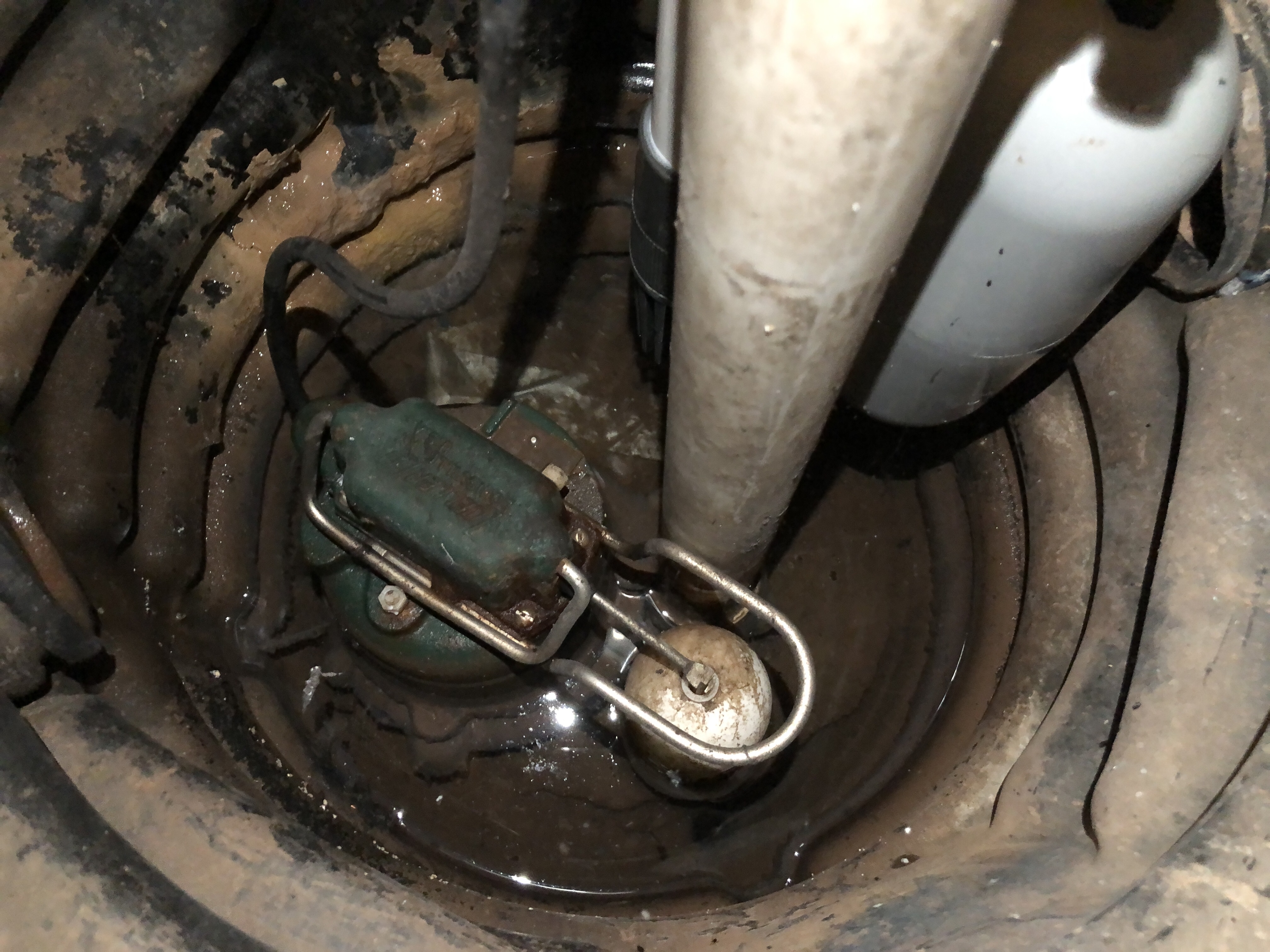
A newly installed sump pump with a discharge pipe. For floodplain homes, a battery backup unit is a standard addition given the likelihood of power outages during storm events.
Battery Backup and Redundancy
Sump pumps run on electricity. Major flood events frequently coincide with power outages — exactly when the pump is needed most. Battery backup sump pumps use a secondary pump connected to a large sealed battery, which activates automatically if the primary pump fails or loses power. Some installations use a water-powered backup pump that operates from municipal water pressure rather than electricity, though this option is only available where municipal water supply is continuous and at adequate pressure.
For properties in high-risk flood zones — areas designated as 1-in-100-year or more frequent flood hazard areas on provincial flood-hazard maps — contractors often specify dual primary pumps with separate float switches, so that one acts as the backup even when grid power is available.
Backwater Valves
When a combined or sanitary sewer system backs up during a flood event, water and sewage can enter a home through basement floor drains and toilet connections. A backwater valve (also called a sewer backup valve) installed on the main drain line allows flow in one direction only. If the municipal system backs up, a flap inside the valve closes automatically, blocking the reverse flow.
Several provincial governments and many municipalities in flood-risk areas offer rebate programs for backwater valve installation. In Alberta, for example, the City of Calgary's Basement Flooding Subsidy Program has covered a portion of installation costs for eligible properties. Rebate eligibility and amounts vary by municipality and change over time; current information is available through municipal engineering or utilities departments.